
Insurance
Bima Sugam: India’s UPI Moment for Insurance | Digital Insurance Revolution 2025
How Bima Sugam is transforming India’s insurance landscape through digital unification and policyholder empowerment.
Bima Sugam: Will This Be India’s UPI Moment for Insurance?
India’s insurance ecosystem, though rapidly digitizing, remains fragmented. Customers juggle between insurers, agents, aggregators, and physical paperwork, especially when it comes to renewals or claims. Bima Sugam, a flagship initiative of IRDAI, seeks to change this. Much like UPI revolutionized payments, Bima Sugam aims to become India’s unified digital marketplace for insurance simplifying policy purchase, management, servicing, and claims across life, health, and general segments.
What Bima Sugam Will Do for India’s Insurance Ecosystem
Bima Sugam will unify the entire policy lifecycle, from onboarding and purchase to servicing, renewal, portability, and claims on one digital interface. Customers will have a centralized e-Insurance Account (e-IA) linked to Aadhaar or PAN, holding all their policies across insurers. Key features include:
- Instant digital KYC and policy issuance
- Multi-insurer product comparison and purchase
- Renewals, nominee updates, and endorsements in one click
- Online claim intimation, tracking, and dispute resolution
- Intermediary access via agent/broker dashboards
- Integration with health networks, TPAs, and the upcoming National Health Claims Exchange
For the customer, this means one portal, one login, all policies and full transparency in pricing, features, and servicing.
Bima Sugam Benefits for Insurers, Intermediaries, and Customers
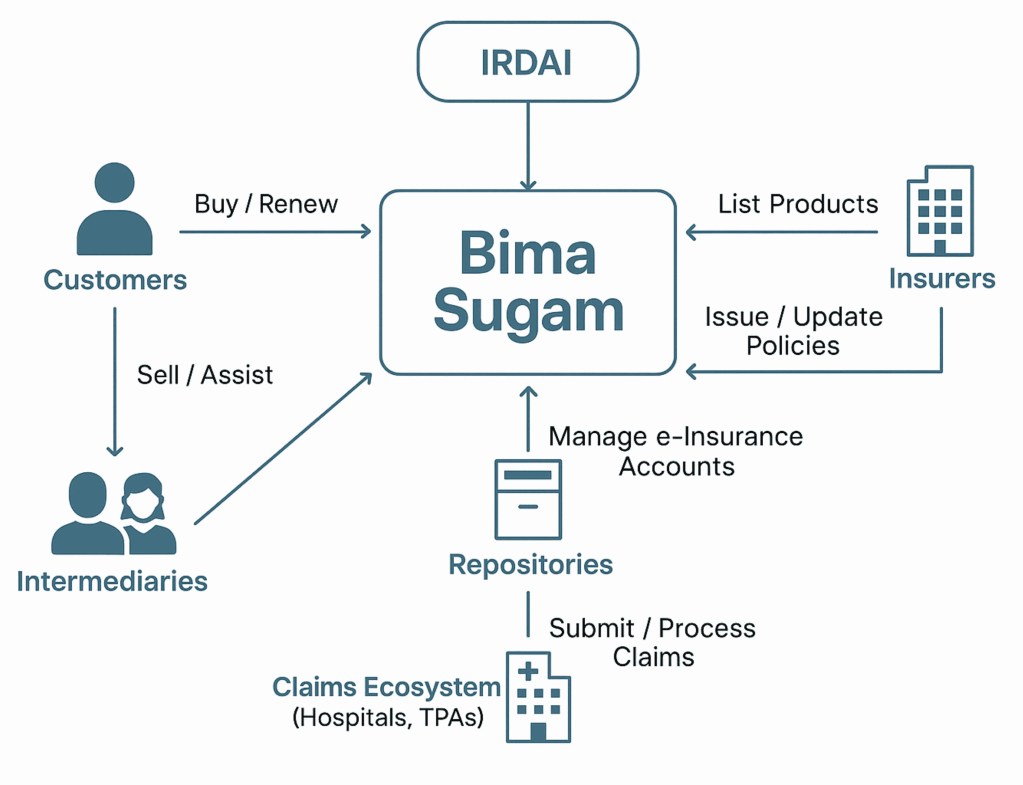
How Bima Sugam Helps Insurers Gain Reach and Reduce Costs
Smaller and regional insurers get nationwide visibility without the overhead of a distribution army. The open platform reduces customer acquisition costs, minimizes paperwork, and improves service consistency. Insurers also benefit from reduced fraud, better data, and real-time insights into policy performance.
Bima Sugam’s Role in Empowering Insurance Intermediaries
Contrary to concerns, agents and brokers aren’t being sidelined, they’re being digitally enabled. Each will have a Bima Sugam login to manage clients, complete onboarding, and issue policies. Commissions and customer tagging remain intact. The platform will also power Bima Vahak, IRDAI’s rural, women-led distribution network, who will use the portal to offer bundled and basic products like Bima Vistaar.
How Bima Sugam Will Transform Customer Experience
Policyholders especially in Tier 2/3 towns and villages gain full access and control. With built-in eKYC, multilingual support, and direct renewals, Bima Sugam removes dependency on third parties while still offering agent-assisted options. Claims tracking and grievance escalation will also be integrated, improving service trust.
Why Bima Sugam Is Called the “UPI of Insurance” in India
Like UPI, Bima Sugam is built around:
Interoperability: All insurers, one platform
Open APIs: Plug-and-play ecosystem for innovation
Regulatory trust: Oversight by IRDAI
Consent-based architecture: Customer retains data control
This platform is not just a policy-buying tool, it’s a new digital infrastructure layer. It could power embedded insurance, micro-covers, and paperless portability, just as UPI powered wallets, BNPL, and real-time lending.
Status and the Road Ahead
After multiple rounds of planning, consultation, and phased regulatory support, Bima Sugam is finally moving from vision to execution. As of mid-2025, the Section 8 company to operate Bima Sugam has been incorporated, with a board in place, including industry and IRDAI nominees. Capital contributions from life, general, and health insurers are underway, and early-stage API integration work is progressing steadily across key participants.
The technology development is being handled by a dedicated consortium, including insurers and InsurTech partners, with rigorous user acceptance testing (UAT) conducted in phases. The architecture is designed to support high concurrency, real-time eKYC, digital policy issuance, and consent-based claims processing. A pilot rollout for internal stakeholders has already been executed, focusing on Bima Vistaar, policy onboarding, and e-Insurance Account functionalities.
The IRDAI has published the Bima Sugam regulations, providing a legally binding framework for how the platform will operate including mandatory data sharing standards, agent registration protocols, consent architecture, and consumer protection guidelines. These rules bar competing marketplaces and establish Bima Sugam as a neutral, public-utility-style exchange.
Looking ahead
A phased public launch is expected between Q3 and Q4 of 2025.
- Phase 1 will include policy comparison, purchase, renewal, e-IA creation, and agent-assisted onboarding.
- Phase 2, targeted for 2026, will add advanced features such as claims intimation, third-party integrations (e.g., hospitals and TPAs), health data APIs, and portability workflows.
- Phase 3 could include cross-sector innovation such as embedding insurance in e-commerce, integrating with UPI for payments, or linking with DigiLocker and Account Aggregator for seamless data flows.
Bima Sugam’s success will depend not just on its tech readiness, but on how quickly insurers integrate, intermediaries adopt, and consumers trust the platform. The next 12–18 months will be pivotal marking the transition of Bima Sugam from a regulator’s blueprint to a living, breathing layer of India’s digital insurance infrastructure.
Recent Posts
Related Posts

DPDPA in Indian Insurance: Privacy-Led Innovation Guide
EV Insurance in India: Challenges, Trends & Opportunities

From Hassle to Instant: The Future of Insurance Claims
DPDPA Meets AI: Regulating the Future of Intelligent Insurance

Connected Coverage: How Telematics and Wearables Are Reshaping Insurance in India