
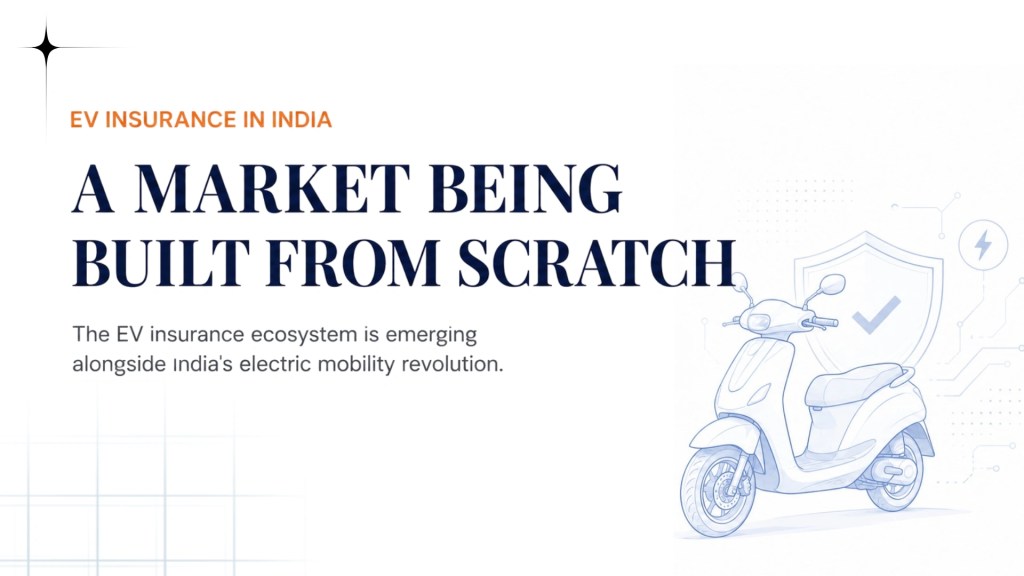
EV Insurance in India
A Market Being Built From Scratch
The two-wheelers came first. The complexity arrived with them. India's EV transition is accelerating and the insurance infrastructure is racing to keep pace with a market that must be rebuilt from the ground up.
India’s motor insurance market is already large. But it was built entirely around the combustion engine. The electric vehicle transition doesn’t just add new vehicles to existing frameworks it challenges the underlying logic of how motor risk is assessed, priced, and settled.
The policy backdrop: what’s driving EV growth
India's EV policy architecture explained
FAME I & II
Faster Adoption & Manufacturing of EVs India's flagship EV demand subsidy scheme. FAME II disbursed over ₹10,000 crore, targeting electric 2W, 3W, buses and charging infrastructure. Ended March 2024.
FAME III (incoming)
Currently being structured. Expected to redirect subsidy focus toward charging infrastructure density and commercial EV fleets, rather than direct purchase subsidies for consumers.
PM E-Drive
Successor scheme launched Oct 2024 with ₹10,900 crore outlay focused on e-buses, e-trucks, and public charging infra. Signals government's shift toward fleet and public transport electrification.
State policies layer on top: Delhi offers ₹5,000–30,000 purchase incentives + road tax waiver. Maharashtra targets 10% EV share by 2025. Tamil Nadu and Gujarat are competing for EV manufacturing investment with PLI-linked incentives. The combined effect is a multi-level push that is compressing the EV adoption curve faster than any single central scheme could.
Why India's insurance problem is uniquely its own
The two-wheeler paradox
Over 80% of Indian EV sales are two and three-wheelers Ola Electric, Ather, TVS iQube, Bajaj Chetak are the volume leaders. Battery packs represent 50–70% of ex-showroom price. A moderate collision can be a total loss purely on battery economics, with no equivalent in ICE underwriting.
Policies still treat the battery as a standard part
Battery degradation, thermal damage, and cell-level failures from road shock sit in policy grey zones under most current wordings. Fewer than 1 in 5 EV owners in India carry dedicated battery protection cover. Awareness is low; claims become disputes.
Repair infrastructure is the hidden bottleneck
India has 3+ lakh registered auto workshops. Fewer than 2,000 are EV-certified for high-voltage systems almost entirely in Tier-1 cities. Parts wait times and transport to authorized centers inflate indemnity costs in ways current premium structures haven’t absorbed.
45°C summers stress batteries beyond design limits
Rajasthan, Gujarat, and the Indo-Gangetic belt regularly exceed 45°C in summer. Most imported battery chemistries weren’t designed for this sustained stress. Thermal degradation is faster; thermal event risk is higher. No standardized claims protocol exists for lithium-ion runaway in Indian conditions.
Battery swapping breaks the risk ownership model
India’s swap ecosystem Sun Mobility, Gogoro partnerships, NITI Aayog’s framework creates a structural gap: when the battery isn’t owned by the vehicle owner, who insures it? Liability between swap network, owner, and insurer remains unresolved and this is core infrastructure, not an edge case.
The commercial fleet EV insurance product purpose-built for Indian operating conditions does not exist in mature form today. With logistics and ride-hail operators electrifying at scale, this is one of the most immediate and concrete product gaps in the market.
What IRDAI is signalling from the 2024-25 annual report
Regulatory moves worth watching
- Pay as You Drive (PAYD) officially introduced. IRDAI’s 2024-25 report explicitly calls out PAYD as an innovative usage-based motor product premium calculated on actual distance driven. This is the regulatory foundation for UBI in India, now on record.
- Depreciation-inclusive policies and roadside assistance mandated as advised product innovations for motor insurance directly relevant to EV total-loss and breakdown economics.
- Salvage management is now the insurer’s responsibility. For EVs, where battery salvage value is significant and complex, this shifts a meaningful operational and financial burden onto the insurer and requires new battery salvage capability most carriers don’t have.
- Bima Sugam (Electronic Marketplace) Regulations, 2024 notified. The digital insurance marketplace is now formal regulation creating the distribution infrastructure through which EV-specific products can reach buyers at scale.
- “Insurance for All by 2047” remains the north star. EV insurance coverage gaps are directly contrary to this goal which gives IRDAI strong motivation to push for faster product innovation in this space.
Where the winners will play
Usage-based insurance (PAYD/PHYD)
IRDAI has now formally sanctioned Pay as You Drive. EVs generate continuous telemetry braking, charging frequency, battery management. The insurer that operationalises this first builds a proprietary pricing edge.
Battery health scoring
A battery at 95% state of health vs 72% is a fundamentally different risk. Every EV is priced identically today. This underwriting product doesn’t exist in India yet the first mover owns the category.
Embedded insurance at OEM
Ather Care and Ola’s bundled offerings have already started this. Deep OEM and NBFC partnerships at point-of-sale mean lower acquisition costs, higher coverage rates, and data access that open-market policies can’t get.
Subscription-based coverage
India’s EV buyer is younger and subscription-native. Monthly motor insurance already tested by Acko fits city two-wheeler usage far better than annual policies. For low-mileage city riders, this is a product-market fit waiting to scale.
Commercial fleet insurance
Battery degradation riders, telematics-linked premiums, charging infrastructure liability, EV-specific business interruption. Build this stack for fleet operators in FY26 and own relationships with India’s fastest-scaling logistics and mobility companies.
Largest immediate gap
Parametric triggers
Auto-payouts when battery diagnostics drop below a defined threshold. The technology is feasible today via OEM telemetry. The governance framework for data flow is what’s missing whoever solves that unlocks the product.
Three fault lines to watch
1. Battery economy infrastructure.
India needs standardized battery valuation norms, a functioning second-life battery resale market, and clarity on swap network liability. IRDAI’s new salvage responsibility rule makes this urgent carriers need battery salvage capability they mostly don’t have yet.
2. Telematics governance.
PAYD is now regulatory policy. But the data framework how OEM telemetry flows to insurers, under what consent conditions, with what privacy safeguards remains pre-commercial. This governance gap is the single biggest unlock for accurate EV pricing in India.
3. Tier-2 and Tier-3 expansion
The next 5 million Indian EV buyers are in Indore, Jaipur, Surat, and Vijayawada. Risk profiles road quality, temperature, repair access, charging behaviour differ materially from metros. Insurers who extend urban models without adjustment will face loss ratio surprises at scale.
The winners won’t be the insurers that simply adapt existing motor products to EVs. They’ll be the ones that rethink underwriting, claims, and risk management around a vehicle increasingly defined by software, data, and batteries.
The vehicles are on the road. The frameworks to protect them are the defining financial services opportunity of this decade in India.
Recent Posts
Related Posts
EV Insurance in India: Challenges, Trends & Opportunities

Cyber Insurance in India: Closing the Growing Protection Gap

Omnichannel Insurance Distribution in India

Insurer Insurtech Partnerships and the Future of Indian Insurance

From Protection to Prediction: How Analytics Is Reshaping Insurance