
Health Insurance
Gig Workers, MSMEs, and the Missing Middle: Fixing India’s Health Protection Gap
A look at how India can close its massive health protection gap by covering gig workers, MSMEs, and the uninsured middle.
Who Are the Missing Middle?
India’s journey towards universal health coverage is far from complete. While schemes like Ayushman Bharat (PM-JAY) have helped insure the poorest 40% and employer-sponsored or social insurance (like ESI and CGHS) cover many in the formal sector, a massive section estimated at over 400 million people remains excluded. This segment, often referred to as the “missing middle,” includes gig economy workers, MSME employees, self-employed individuals, and informal sector participants.
Public Schemes: Why They’re Not Enough
Flagship public health insurance schemes like PM-JAY and ESI have undeniably expanded India’s coverage net. Yet their structure inherently leaves gaps:
PM-JAY targets only the bottom income percentile based on SECC data, excluding those just above the poverty line who may still be financially vulnerable.
ESI, designed for formal employees, excludes gig workers and many MSME staff because they either don’t meet wage criteria or lack an employer-employee contract.
Even in states with broader schemes, portability and awareness remain limited. Many missing middle households are just a health emergency away from slipping into debt, with out-of-pocket expenses accounting for over 50% of healthcare spending in India.
The Core Challenges
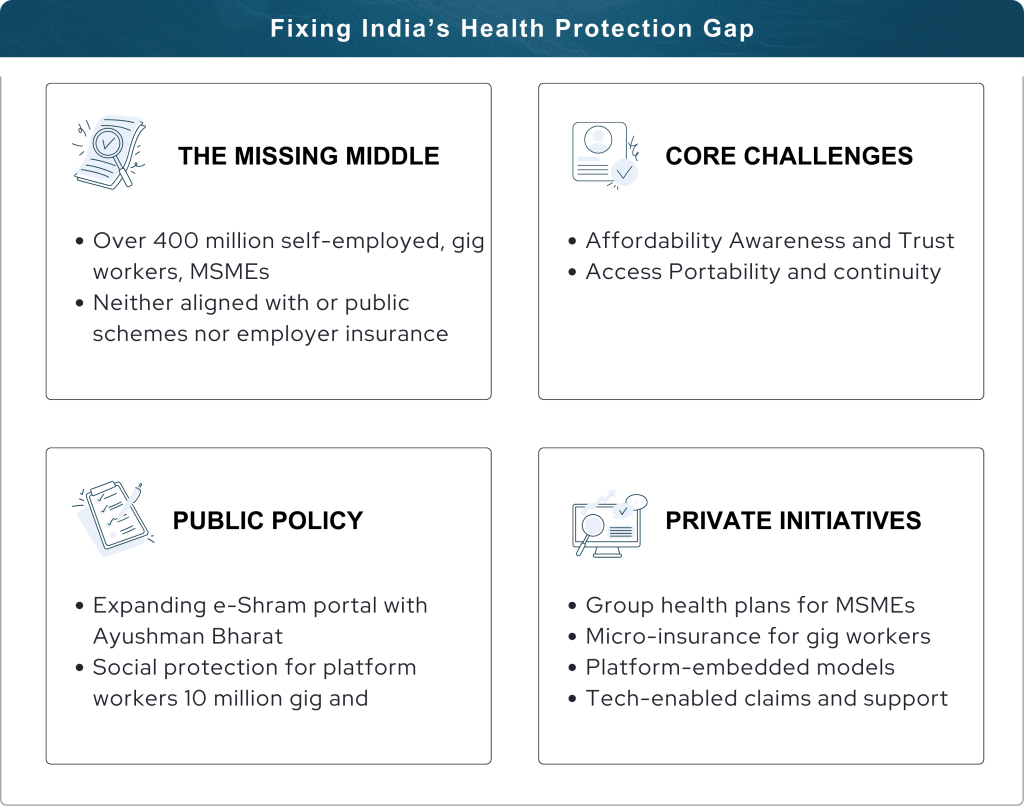
The protection gap is not merely a coverage issue it’s a systemic problem spanning affordability, awareness, accessibility, and trust.
- Affordability: Commercial health policies often start at ₹10,000+ per year for a family. For many gig workers or small business staff, this is unaffordable. Even IRDAI’s “affordable” standard plan, Arogya Sanjeevani, remains out of reach for millions.
- Awareness & Trust: Many in this group have never bought insurance and are unaware of how it works. Low financial literacy and prior negative experiences with claims often fuel mistrust.
- Access: Traditional agent-based distribution doesn’t reach this segment. Many live in rural or peri-urban areas and rely on informal networks for financial decisions. MSME employees often work in small, scattered units, making it hard to scale employer-based models.
- Portability & Continuity: Gig workers and informal sector employees frequently change jobs or migrate. Insurance tied to employers or geography simply doesn’t work for their reality.
A Policy Turning Point: Gig Workers & e-Shram
The Union Budget 2025-26 marked a historic shift. The government announced that gig and platform workers would be enrolled in Ayushman Bharat via the e-Shram portal—granting them and their families ₹5 lakh health cover. This move formalizes social protection for nearly 10 million workers on platforms like ride-hailing, food delivery, and home services.
The policy represents a blueprint: use digital identity (e-Shram), public infrastructure (PM-JAY), and platform cooperation to bring gig workers into the social safety net. If executed well, this could eventually extend to other informal workers and self-employed individuals in the missing middle.
The Private Sector Response: Insurtech and MSME Innovation
1. Group Health for MSMEs
Platforms like Onsurity, Plum, and Loop Health offer group health insurance to businesses with as few as 2–3 employees. MSMEs can enroll staff on subscription-based plans starting from a few hundred rupees per employee per month. These plans often include OPD, mental health, and teleconsultation making insurance more usable.
2. Bite-Sized and Micro Insurance
A Shift in Product Thinking
What’s clear is that a one-size-fits-all approach won’t work. This population needs:
Flexibility: Subscription-based, monthly payments.
Portability: Plans that are not tied to an employer.
Utility: Day-to-day value through OPD and telemedicine.
Affordability: Pricing under ₹100/month where possible.
Insurance must evolve into a health benefit service, not just a financial product.
What’s Next?
The road ahead will be shaped by:
- Effective rollout of gig worker coverage via e-Shram.
- Better data integration across public and private schemes.
- Product innovations that blend outpatient, wellness, and catastrophic cover.
- Wider use of digital platforms for education, distribution, and claims.
This is more than a financial challenge it’s a trust and access challenge. The good news? India’s regulators, insurers, and startups seem aligned on one goal: bridging the protection gap for the underserved millions.
Recent Posts
Related Posts
EV Insurance in India: Challenges, Trends & Opportunities

Cyber Insurance in India: Closing the Growing Protection Gap

Omnichannel Insurance Distribution in India

Insurer Insurtech Partnerships and the Future of Indian Insurance

From Protection to Prediction: How Analytics Is Reshaping Insurance